The Narragansett was one of the earliest domestic turkey varieties in the American colonies. Once commonly found foraging in colonial farmyards, Narragansett turkeys eventually lost favor to faster growing and therefore more cost-effective industrially developed broad-breasted turkeys. Today, however, these picture-perfect Pilgrim-era turkeys are making a comeback due to their exceptional hardiness, self-sufficiency, and superior flavor.
Where do Narragansett turkeys come from?
Narragansetts descend from wild turkeys native to North America and domesticated some 2000 years ago. In the 1500s, Spanish colonists introduced these domesticated turkeys to Europe. There they were selectively bred to create the Norfolk Black turkey. Then, in the early 1600s, British settlers brought Norfolk Blacks with them when they arrived here.
To develop the Narragansett, early settlers crossed their Norfolk Blacks with local wild turkeys. Their goal was to combine the larger size of the domestic variety with the hardiness of the wild turkey. Today’s Narragansett still retains the wild turkey’s disease resistance, ability to fly to evade predators, and suitability to cold climates.
How did the Narragansett turkey get its name?
This variety got its name in the 1830s from the Rhode Island’s Narragansett Bay. The bay, in turn, took its name from the Narragansett people indigenous to New England.
What color is a Narragansett turkey?
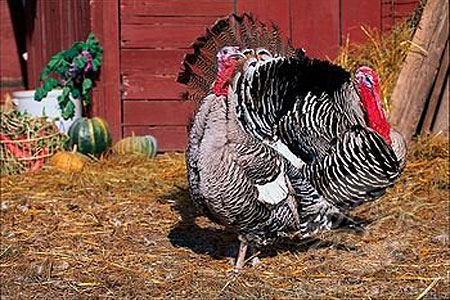
The poults — or baby turkeys — are dark brownish with yellow bellies and penciling on the head and back. At maturity they have mostly black plumage with steel-gray bands. The wings have white bars that are prominent when the wing feathers spread, such as in flight. The black tail has tan parallel lines edged in gray.
The head and neck are mostly featherless and the neck has fleshy protuberances, or caruncles, that range from red to bluish white. Toms sport a black beard on the neck.
What are Narragansetts known for?
Narragansett turkeys are the perfect choice for backyards and farmsteads, because they:
- are calm and docile
- are especially hardy
- forage actively
- are alert to predators
- thrive in cold weather
- are easy to handle
- have strong maternal instincts
- have excellent meat quality
- mate naturally
- are disease resistant
- are low maintenance
Are Narragansett hens good layers?
Narragansett hens begin to lay at 7 to 10 months of age. If allowed to set, they will produce 20 to 25 eggs per spring. If the eggs are removed they will continue to lay up to 40 or 50 eggs. Although production declines after the first two years, a hen’s total productive life is 5 to 7 years.
Are Narragansett hens broody?
Narragansett hens have strong maternal instincts, making them one of the broodier turkey varieties. Clutch size averages 10 to 14 eggs. Because the hens are vigilant and protective, the 8 to 12 poults that hatch have a high survival rate and may stay with the mother hen for up to a year.
Are Narragansett turkeys good for meat?
Narragansetts are excellent to raise for meat. In fact, they were the foundation of New England’s early commercial turkey industry. Because of their superior flavor, Slow Food USA has placed this heritage breed in its Ark of Taste.
Narragansetts have dark pin feathers and therefore don’t dress quite as nicely as a bird with white pin feathers. But, even though they are smaller than commercial hybrids — so the meat yield is less — and grow more slowly, the meat is of higher quality, with a 50:50 ratio of white to dark meat.
Typically they reach market weight in 24 to 28 weeks, compared to 16 to 18 weeks for commercial broad-breasted varieties. That extra growth period accounts for the finer flavor.
How big are Narragansett turkeys?
They are a medium-size bird. Young toms reach market weight at about 23 pounds, young hens at 14 pounds. Mature toms can weigh as much as 28 pounds, hens weigh up to 16 pounds.
Are Narragansett turkeys in the Standard of Perfection?
Yes, Narragansetts have been in the Standard of Perfection since the first edition in 1874. With their striking black plumage edged in white they are quite an attraction at poultry shows.
Do Narragansett turkeys perch like chickens?
Narragansetts do like to perch, like chickens. They fly well and will roost in trees if not trained to sleep inside at night. Position roosts 3 to 4 feet high inside their shelter, and allow 12 to 15 inches of space per turkey.
Are Narragansett turkeys aggressive?
During nesting season, toms can be aggressive, mostly toward other toms or any perceived threat to their hens. Providing adequate space and a sufficient number of hens per tom helps reduce aggression during this time.
What do Narragansett turkeys eat?
As excellent foragers, Narragansetts can glean up to 70% of their diet from insects, seeds, and greens. They therefore need minimal supplemental feed when they have adequate to pasture providing at least one-half acre per dozen birds. Pasture rotation prevents overgrazing and a buildup of pathogens.
The quick-growing poults need a turkey or game bird starter ration supplying 28% to 30% protein for the first 8 weeks. Then transition to a higher calorie but lower protein 20% grower ration until time for processing.
For Naragansetts raised for laying or breeding, continue feeding grower ration for 8 weeks more. Then transition to a 16% to 18% game-bird layer ration. Offer grit and oyster shell free choice and, of course, provide a steady supply of clean fresh water.
Are Narragansetts all-climate turkeys?
Yes, Narragansetts do well in most climates. They are especially cold hardy, although in extreme cold weather their fleshy heads are susceptible to frostbite. And in hot weather, they can suffer heat stress without plenty of water and shade.
Are Narragansett turkeys rare?
Yes. By the late 21st century they were nearly extinct. This variety is on The Livestock Conservancy’s “watch” list and in need of conservation.
By choosing to raise Narragansetts for your table, you cast your vote in favor of locally produced healthful meals. And keeping Narragansetts helps preserve genetic diversity, protecting these unique and beautiful turkeys from extinction.
FAQs
Will Narragansett turkeys interbreed with other turkeys?
Yes. All turkey varieties belong to the same species (Meleagris gallopavo) and therefore can interbreed.
How do Narragansetts evade predators?
They evade predators by being:
- alert and vigilant
- fast on the ground
- able to fly short distanced
- too big for raptors
Do Narragansett turkeys fly?
Yes. They can fly to reach high roosting sites and to evade predators. However, they generally remain within a limited home range when provided with adequate resources.
How big are Narrraganett eggs?
The eggs are approximately 3 inches long with an average weight of 2.5 to 2.8 ounces.
What color are the eggs?
Narragansett eggs range from ivory to tan to shades of medium brown, and have light brown speckles.
Are Narragansett turkeys friendly?
Narragansett turkeys are calmer than other turkey varieties and socialize well with humans when handled regularly from an early age. They therefore make excellent backyard pets.
Helpful Links
Narragansett Poults from Cackle Hatchery®
Heritage vs. Broad Breasted Turkeys
And that’s today’s news from the Cackle Coop.
Gail Damerow is editor and principal author of Backyard Homestead Guide to Raising Farm Animals, which includes a section on raising turkeys such as Narragansetts.