

Description
Reeves pheasants (Syrmaticus reevesii) get their name from British naturalist John Reeves, who discovered the species in the forests of central and eastern China. This pheasant has since become rare in the wild because of habitat loss and because of over-hunting for the male’s extremely long tail feathers — the longest of any wild bird.
Reeves pheasants are generally recommended for experienced pheasant keepers. Because they are large and have extremely long tail feathers, they require a considerable amount of living space. Further, the males tend to be aggressive toward each other and toward humans,
Description
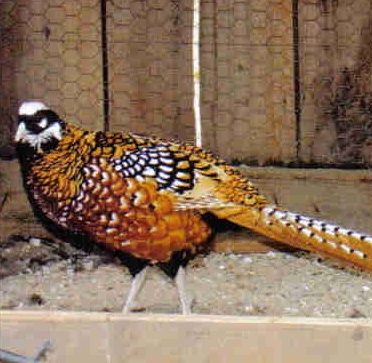
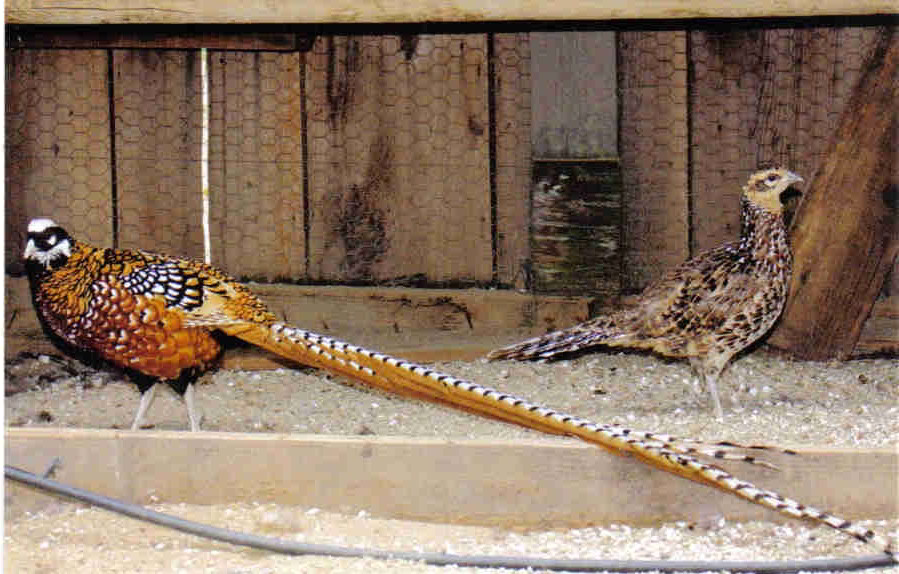
The male (cock) is a golden color with markings in light chestnut, black, brown, and white. The head is white with a black mask. The long tail has a black-and-white pattern. The tail feathers grow about 12 inches a year, and molt regularly, along with the rest of the feathers.
The mottled female (hen) sports less bold tones of brown, buff, and white for better camouflage while nesting. The head is a cream-color with a brown mask. She is smaller than the male, and has a shorter tail. The young are similar to the female.
| Average | Male | Female |
| Weight | 2.7 lbs | 2 lbs |
| Length | 82 in | 30 in |
Habitat
In their natural forest habitat, Reeves Pheasants spend the day foraging on the ground and the night roosting in trees. They therefore prefer a woodland-like aviary with shrubs and high perches. To avoid damage to the male’s long tail, the aviary must be at least 250 square feet per pair.
These pheasants do well in both warm and cold climates, but require dry conditions to protect the male’s tail feathers. An entirely enclosed aviary will keep them from flying away. It must also be predator proof and provide protection from the elements.
Diet
In their natural habitat, Reeves pheasants eat mostly vegetable matter such as seeds, grains, and various types of plants. They also eat insects and other small invertebrates. In captivity, adults do well on gamebird ration supplemented with greens, fresh produce, mealworms, worms, and other invertebrates.
The addition of oyster shell ensures strong egg shells. Chicks should be fed a high-protein gamebird starter. And, of course, fresh clean water should always be available.
Temperament
Reeves Pheasants are particularly aggressive toward other birds, toward each other, and toward humans, especially during breeding season. Because they would otherwise fight, house only one male per aviary and provide visual barriers between pens.
Even the chicks can be aggressive when brooded with other types of chicks. Handling birds while they’re young can keep them relatively tame.
Lifespan
In a clean environment with good nutrition, and treated for parasites, Reeve’s pheasants will live 5 to 9 years.
Breeding
Reeves Pheasants start breeding after their first year, and may be housed in pairs or trios. The hens prefer to nest on high ground.
- Breeding season: April through July
- Clutch size: 6 – 14 eggs
- Egg color: Olive
- Incubation period: 24 – 25 days
Other Cackle Hatchery® pheasants you might like are Ornamental Pheasant Chicks and Mature Pheasant Pairs.
We can not ship grown fowl to Minnesota.


Reviews
There are no reviews yet