
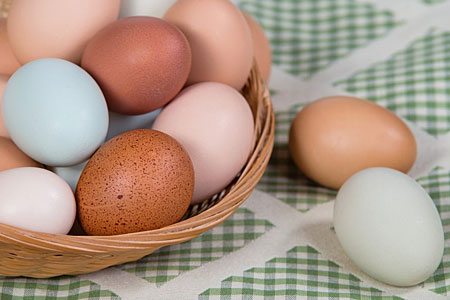
Chickens are seasonal layers. Homegrown eggs therefore don’t arrive at the same rate year around. Sometimes you get too many. Sometimes not enough. Here are seven ways to store your farm fresh eggs, from countertop storage to dehydration. By extending their shelf-life, you can save them for when your hens take a vacation from laying.
Do Nothing
You may be surprised to learn how long eggs will keep on the countertop if they are clean, fresh, and unwashed to preserve their protective bloom. At a room temperature of 70ºF they will keep for two to three weeks, assuming they have never been in a refrigerator.
Tip: An egg that is moved from a refrigerator to room temperature will develop condensation. Condensation can cause bacteria to enter through the porous shell.
Tip: Industrially produced eggs by law must be washed, sanitized, and remain under constant refrigeration. They are therefore unsuitable for countertop storage.
Refrigerate Fresh Eggs
In the refrigerator, farm fresh eggs store well for 30 to 45 days. In cold storage, where the temperature is a steady 30ºF, eggs will keep for up to nine months. Hard cooked and left in the shell, they will keep in the fridge for about two weeks.
Store Farm Fresh Eggs in the Freezer
Eggs frozen at a temperature of 0°F will keep for up to one year. A handy way to freeze them is in ice cube trays. Once the cubes have frozen, remove them from the trays and store them in an air-tight freezer container. Three tablespoons of thawed whole egg equals one large fresh egg.
Pickle Excess Farm Fresh Eggs
Anyone who loves pickles likes pickled eggs. Pickling is an ideal way to use the eggs from bantam chickens or the first small ones laid by pullets. The easiest way to pickle eggs is to cover them in the brine left over from your favorite cucumber or other type of pickles.
Pickled eggs need time to absorb flavors from the brine: 1 to 2 weeks for small ones, 2 to 4 weeks for larger ones. Keep them in the fridge and serve them within 4 months.
Store Excess Eggs in Waterglass
Liquid waterglass as an egg preservative seals the shell’s pores to minimize evaporation and inhibit bacteria from entering. Waterglass (sodium silicate) imparts no taste or odor. It causes a silica crust to develop on the outside of the shell, but does not penetrate the shell.
This method might preserve eggs indefinitely. But to be safe, let’s say up to 18 months in a cool, dark pantry.
Store Excess Eggs in Limewater
An alternative to waterglass is limewater (calcium hydroxide), which is simply food grade lime dissolved in water. Food grade lime is a white, odorless powder sold as pickling lime, sometimes found in the grocery store canning department. The best known brand is Mrs. Wages pickling lime. Eggs preserved in limewater and stored in a cool, dark pantry will last for at least 18 months.
Dehydrate Surplus Eggs
The best method for long-term storage is to dehydrate eggs in a regular food dryer. Be mindful, though, that raw liquid egg can’t leak out of the dryer trays to create a mess.
Dry eggs whole, or dry the yolks and whites separately. The reconstituted powder tastes much the same as fresh or frozen eggs.
One dozen dehydrated powdered eggs will fit into a half-pint canning jar and, tightly sealed, will keep for years. One tablespoon of powder plus one tablespoon of hot water roughly equals one egg.
In Summary
Assuming the eggs are stored fresh, are clean, and have never been washed, the following table shows the approximate storage time for each method.
|
Method |
Storage Time |
|
Countertop |
2-3 weeks |
|
Refrigerator |
30-45 days |
|
Pickled |
4 months |
|
Freezer |
1 year |
|
Waterglass |
1-1.5 years |
|
Lime water |
1-1.5 years |
|
Dehydrated |
2 years |
Frequently Asked Questions
How long can you store farm fresh eggs unrefrigerated?
They will keep unrefrigerated for two to three weeks at a room temperature of 70ºF.
What is the safest way to store fresh whole eggs?
The safest way to store fresh eggs is in the refrigerator.
How soon should you refrigerate freshly laid eggs?
Eggs destined for the refrigerator should be stored there as soon as possible after gathering them from the nests.
Should you wash eggs before storing them?
No. For long-term storage use only fresh, clean, unwashed eggs.
When should you not eat a farm fresh egg?
Do not eat an egg, not matter how fresh, if it is dirty or cracked. Also don’t eat one that you “find” somewhere and you don’t know how long it was there.
Otherwise, enjoy your farm fresh eggs. And when your busy hens give you extras, preserve them for future use.
And that’s today’s news from the Cackle Coop.
Gail Damerow has raised chickens and various other poultry for more than 5 decades and has written numerous books about them, many available from the Cackle Bookstore.