One of the realities of breeding chickens is experiencing deformities in newly hatched chicks. Most of the time deformed embryos don’t survive to hatch, but sometimes one does. The more eggs you hatch, the more likely you are to occasionally find hatched chicks with deformities of one sort or another.
Why deformities happen in newly hatched chicks.
Deformities in hatched chicks are often entirely random. But when a specific deformity occurs regularly, look for issues in your breeder flock or in your incubation technique.
Unfortunately, many chick deformities have more than one cause, making them hard to track down. Here are the most likely factors involved in deformities of newly hatched chicks:
- Hereditary factors in the breeder flock strain or breed
- Prolonged inbreeding
- Disease in breeder flock
- Nutritional deficiencies or imbalance in breeder flock diet
- Mycotoxins in breeder ration
- Excessive breeder flock age
- Mishandling hatching eggs during storage, especially jarring them
- Storing eggs under improper temperature and humidity
- Storing hatching eggs for longer than 10 days
- Letting eggs chill before the start of incubation.
- Too high temperature during incubation, which accelerates growth
- Too low temperature during incubation, which retards growth
- Fluctuating temperature during incubation
- Helping chicks out of shell
What are common deformities in hatched chicks?
|
Deformity |
Description |
|
Crossed beak/scissor beak |
Upper and lower beaks cross |
|
Parrot beak |
Upper beak is too long or the lower beak is too short |
|
Missing eye(s) |
May or may not have rudimentary eye tissue |
|
Spraddle/splay leg |
Legs collapse and point to the sides |
|
Extra leg(s) |
Extra legs attached anywhere on the body; may be shrunken or deformed |
|
Crooked toes |
Toes twisted, bent sideways, or curled under foot |
|
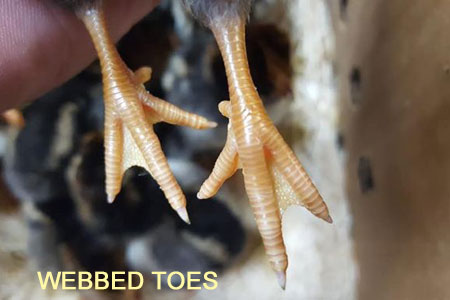
Webbed toes |
Two or more toes fused together |
|
Intestines outside body |
Intestinal loops exposed near naval |
|
Exposed brain |
Soft bubble on top of the head, skull bone fails to close |
|
Crooked neck |
Head held in abnormal position |
How to avoid deformities in hatched chicks.
“Deformities in hatched chicks are rare,” says Jeff Smith of Cackle Hatchery®. “Across all breeds, mild deformities average 1 out of 1000. Extra legs maybe 1 out of 750,000.
“But deformities do occasionally happen, especially when you work with large numbers of chicks. It is one of the realities of livestock breeding. Of course we try to catch anything that is abnormal, especially the common defects in some breeds, like cross beak.”
When you hatch your own chicks, any with minor deformities — like cross break or splayed legs — often survive well with supportive care. But the better option is to minimize the possibility of deformities in hatched chicks by observing these measures:
- Do not breed deformed chickens or those that produce deformed chicks.
- Do not breed a chicken that you helped hatch of its shell.
- Avoid inbreeding.
- Maintain a healthy and vigorous breeder flock.
- Feed breeders a fresh, high protein ration.
- Properly store hatching eggs before incubation.
- Optimize incubator operation.
FAQs
What causes a chick to hatch with a crossed beak?
Causes of cross beak are varied and numerous. The condition is a genetic defect for some breeds, notably about 5% in Easter Eggers and, to a much lesser extent, Ameraucanas. It could also result from excessive humidity or malposition of the embryo during incubation. Chicks with crossed beak may survive with supportive care.
What causes splayed legs in newly hatched chicks?
Splayed leg occurs because the leg bones, muscles, and tendons are simply not strong enough for the chick to stand on. Most of the time it happens because the chicks hatch on a too-slick surface that their toes can’t grab. Another cause may be an incubation or hatching temperature that’s too high, affecting leg development. Lack of strength may also result from an inadequate breeder-flock diet. A chick with splayed legs is likely to recover with splinting.
What causes chicks to hatch with crooked toes?
The most common cause of crooked toes in newly hatched chicks is low or fluctuating incubation temperature. Crooked toes may also result from too high temperature during early incubation, or may be a hereditary issue.
What causes a newly hatched chick to have extra legs?
Extra legs are usually caused by a genetic issue. Or they might result from fluctuating incubation temperature. A chick with extra legs looks strange, but may get along quite well.
What causes a chick to have webbed toes, like a duck?
Webbed toes could be genetic, as in black tailed red Marans. But may also be caused by improper incubation conditions or faulty breeder flock diet. This condition may require surgery to improve the bird’s mobility.
What causes a chick to hatch with an exposed brain?
An exposed brain usually means the incubator temperature was too high, especially toward the beginning of incubation. Also it could be a genetic issue, particularly for crested breeds. Most such chicks don’t survive for long.
What causes a chick to hatch with a crooked neck?
A crooked neck in hatched chicks usually results from being stuck in the shell too long before breaking loose or being helped out. Such a chick may recover with supportive therapy. On the other hand, a chick with epileptic-like muscle spasms that pull the head back with the beak pointing skyward rarely survives. This neurological condition, called congenital loco, is usually genetic, but may also result from an improper breeder flock diet.
What causes a chick to hatch with one or both eyes missing?
High temperature during incubation can result in chicks with missing eyes. Although the socket may contain rudimentary eye tissue, the eye itself is missing. Don’t confuse this deformity with eyes stuck shut, which results from low humidity and may be easily remedied by gently wiping the eye area with a warm, damp cloth.
How to prevent deformities in hatched chicks.
To minimize deformities in hatched chicks: Do not breed deformed or aging chickens. Feed breeders a high protein ration. Hatch only eggs that are less than 10 days old. Know how to properly store eggs for hatching and how to correctly operate your particular incubator.
And that’s today’s news from the Cackle Coop.
Gail Damerow has raised chickens and various other poultry for more than 5 decades and has written several books about them, including Hatching and Brooding Your Own Chicks, available from the Cackle Bookstore.