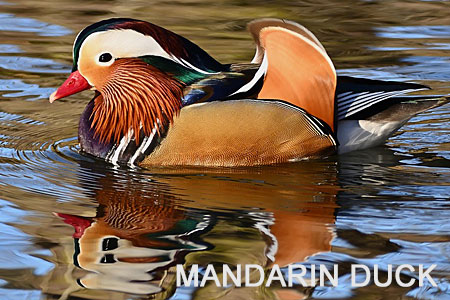
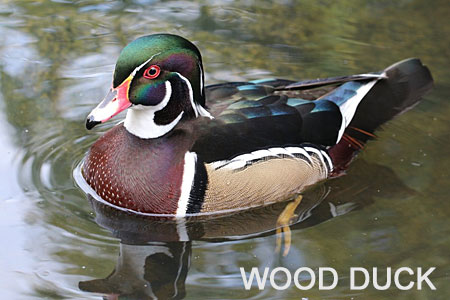
Mandarin ducks and Wood ducks are both extremely colorful and are often mistaken for one another. Although they easily may be confused, they originate from different continents and have a few other key distinguishing features. Primary among these features is the plumage pattern of the respective drakes. First let’s look at the similarities.
Mandarin Ducks and Wood Ducks — Similarities
Mandarin ducks and Wood ducks are both mid-size colorful birds in the genus Aix. They share these additional similarities:
- Both are omnivorous
- Both forage in water and on land
- They both nest in tree cavities
- They have strong claws for tree climbing
- They are both excellent fliers
- Both species are shy and elusive
- Both have a natural lifespan of 3-4 year
- In captivity both can live 10 year or more
Mandarin Ducks and Wood Ducks — Differences
Mandarin ducks and Wood ducks may look similar at first glance. Although they are the only two members of the genus Aix, they are two different species from two different native ranges. Mandarin ducks (Aix galericulata) are native to East Asia. Wood ducks (Aix sponsa) are native to North America, primarily the United States.
Their native habitats are similar, with some differences. Mandarin ducks prefer densely forested areas with slow-moving and shallow lakes, ponds, rivers, and streams. Wood ducks, on the other hand, favor wooded areas with freshwater swamps, marshes, streams, and riverbanks.
Wood ducks are also more flexible in their habitat choices. And they enjoy a balanced diet between plant and animal matter, while the Mandarin’s diet is more plant based.
Behaviorally, the Mandarin duck is more solitary and territorial, and more likely to remain monogamous. The Wood duck, by contrast, is more social and gregarious, and more likely to change partners between breeding seasons.
But several key visual differences can help you tell them apart.
|
Feature |
Mandarin Duck |
Wood Duck |
|
Male Plumage Color |
Vibrant orange, green, purple |
Iridescent green, purple, white |
|
Male Head Color |
Multi-color |
Green |
|
Male Plumage Pattern |
Patchwork |
More blended |
|
Unique male feature |
Sail-like feathers on back |
Red eyes |
|
Female Plumage |
Gray, brown, white; distinct markings |
Similar; less distinct markings |
|
Leg Color |
Bright red |
Dull orange |
|
Body Shape |
Stockier |
More slender |
|
Bill Shape |
Narrow, pointed |
Broad, flat |
|
Crest Shape |
Long, curved |
Short, small |
|
Tail Shape |
Short, rounded |
Long, pointed |
|
Vocalization |
Quiet, low-pitch |
High-pitch whistling |
|
Clutch size |
8-12 eggs |
6-16 eggs |
|
Length |
16-19 inches |
17-20 inches |
|
Weight |
1-1.5 pounds |
1-1.3 pounds |
Frequently Asked Questions
Are Mandarin ducks the same as Wood ducks?
No, they are not the same. They are two different species.
Are Mandarin ducks and Wood ducks related?
Yes, they are closely related. They are the only two species in the genus Aix.
Do Wood ducks and Mandarin ducks look alike?
They are both mid size colorful ducks that are often mistaken for each other. But with a little knowledge you can easily tell them apart.
Can a Mandarin duck mate with a Wood duck?
Because of behavioral differences, each species normally hangs around with its own kind. Cross mating does occasionally occur, but the resulting eggs are usually infertile. The rare offspring that does develop will unlikely survive to adulthood.
Can a Mandarin or a Wood duck mate with a mallard?
Mandarins and Wood ducks do occasionally mate with mallards. But the eggs typically would be infertile because of differences in their chromosomes.
Are Mandarin ducks and Wood ducks good flyers?
Yes. Both can take off vertically from the water and easily fly through forest areas. To keep them home you either need to pinion them or house them in a covered aviary.
Do you need a permit to keep Mandarin ducks and Wood ducks?
You do not need a permit to keep Mandarin ducks. To capture or keep Wood ducks, you need a federal permit and maybe also a state permit. for details, check with your state’s wildlife agency.
And that’s today’s news from the Cackle Coop.
Gail Damerow has raised chickens, ducks, and various other poultry for more than 5 decades and has written numerous books about them, many available from the Cackle Bookstore.