
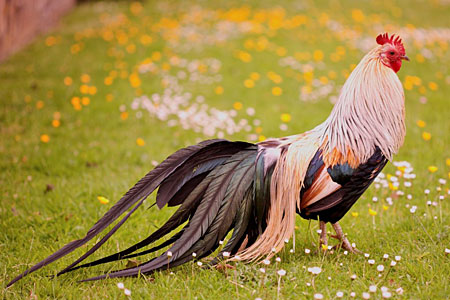
An amazing characteristic of Phoenix chickens is their exceptionally long and multiple tail feathers. Even the hens have more tail feathers than most other chickens.
The Phoenix was developed from the Onagadori, a breed from Japan that has a non-molting gene. Despite its exceptionally long tail, the Phoenix lacks the non-molting gene and therefore molts every year or two.
What is a Phoenix chicken?
Characteristics of the Phoenix chicken include the following:
- Long tail feathers
- Multiple tail feathers
- Long legs
- Lightweight
- Heat tolerant
- Active foragers
- Docile but independent
Where did Phoenix chickens come from?
The breed was created by Hugo du Roi in Germany during the late nineteenth century. It was developed by crossing delicate long-tailed Onagadori birds from Japan with select chickens of a few more vigorous breeds.
The most notable feature of the Phoenix rooster is its long tail feathers. Its Onagadori ancestors had long tails because they carry a gene that keeps them from molting annually, so their tails continue to grow year after year.
The Phoenix rooster lacks this gene, so its tail feathers molt every year or two. But the tail still can grow impressively long with proper care. The breed is kept primarily for exhibition and for its ornamental qualities.
Why is this chicken called Phoenix?
The breed is named after a mythical bird that died in flames and re-emerged from the ashes. Similarly, the Phoenix chicken breed emerged from the challenges facing its less vigorous predecessors.
What color is a Phoenix chicken?
Phoenix chickens come in a number of different colors. Not all of them are available in the United States. And not all of them are listed by either the American Poultry Association (APA) or the American Bantam Association (ABA).
The APA lists five standardized color varieties:
- Silver, admitted in 1965
- Silver bantam, 1965
- Golden, 1983
- Golden bantam, 1983
- Black Breasted Red, 2017
The ABA lists six standardized color varieties of Phoenix bantam, but does not indicate admission dates:
- Golden
- Golden duckwing
- Light brown
- Silver
- Silver duckwing
- White
Phoenix chickens offered by Cackle Hatchery®
Cackle Hatchery offers these standard-size Phoenix chickens:
Cackle Hatchery also offers these Phoenix bantam varieties:
What size is a Phoenix chicken?
|
Age |
Large |
Bantam |
|
Rooster |
5½ lb |
30 oz |
|
Hen |
4 lb |
28 oz |
|
Cockerel |
4½ lb |
28 oz |
|
Pullet |
3½ lb |
26 oz |
Are Phoenix chickens easy to raise?
The main consideration is to provide enough space to protect the roosters’ long tail feathers. They also need a high perch to keep the tail feathers clean and in good condition. A high protein diet also helps maintain their long feathers. Otherwise they are as easy to raise as any other chicken breed.
What are the pros and cons of keeping Phoenix chickens?
|
Pros |
Cons |
|
Elegant and pheasant-like |
Tail feathers require care |
|
Calm, docile |
Easily bullied |
|
Good broody hens |
Fair layers |
|
Heat tolerant |
Not cold hardy |
|
Excellent foragers |
Good fliers |
|
Popular for exhibition |
Judges not always familiar with standards |
Frequently Asked Questions
Are Phoenix chickens rare?
The Livestock Conservancy lists them as “watch”, meaning fewer than 5,000 breeding birds are in the United States, in ten or fewer primary breeding flocks, and the estimated global population is less than 10,000.
What color eggs do Phoenix hens lay?
The shells of Phoenix eggs are slightly off-white to brown tinted.
Are Phoenix hens good layers?
They are fair layers, producing approximately 50 to 125 eggs per year.
What size are Phoenix chicken eggs?
Hens of the larger breed lay small- to medium-size eggs. The bantams lay bantam-size eggs.
Is the Phoenix chicken dual-purpose?
No, they are not considered to be dual-purpose. The hens are only fair layers. As meat birds, these chickens are small and slow-growing, although what little meat they do produce is tasty. The breed is primarily an ornamental, kept for the rooster’s amazing long tail feathers.
Are Phoenix hens broody?
Yes, both bantam and larger Phoenix hens are broody.
Are Phoenix roosters aggressive?
Phoenix roosters are active and can be somewhat aggressive, especially when confronted with unfamiliar situations.
Do Phoenix chickens get along with other breeds?
Yes, Phoenix chickens get along with other chickens, although they can be bullied by more the aggressive breeds.
Are Phoenix chickens friendly?
They can be friendly with humans, especially when handled while young. Phoenix chickens make beautifully regal pets.
Helpful Links
American Phoenix Breeders Association
Care and Feeding of Longtail Roosters
How to Mix Different Chicken Breeds in One Flock
And that’s today’s news from the Cackle Coop.
Gail Damerow has raised chickens and various other poultry for more than 5 decades and has written numerous books about them, many available from the Cackle Bookstore.