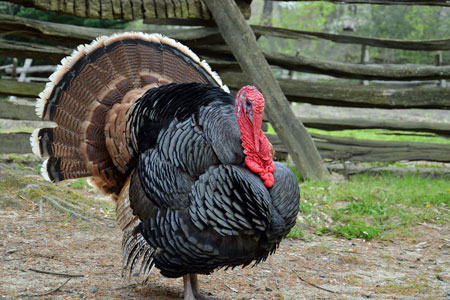
Choosing between heritage vs. broad breast turkeys can be confusing. Although they both come from the same genetic background, they differ in many ways. The former can mate naturally, is slower growing, and smaller in size. The latter grow more quickly and weigh more, but breeding them requires artificial insemination. Plus, largely because of differences in size and growth rate, their meat differs in flavor and texture.
Features of Heritage Turkeys
Heritage turkeys have these features:
- Historic genetics: dating to 1920s or earlier
- Appearance: smaller and leaner
- Natural mating: fertility rate is 70% to 80%
- Longer lifespan: hens are productive for 5 to 7 years, toms 3 to 5 years
- Good for free-range: good foragers, less reliant on commercial rations
- Can fly: short distances
- High roost: up to 6 feet
- Good disease resistance: genetic diversity leads to hardiness
- Smaller size: suitable where space is limited
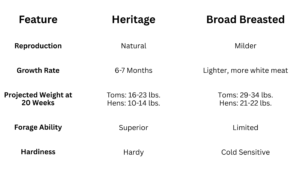
- Slow growth rate: typically harvested at 6 to 7 months
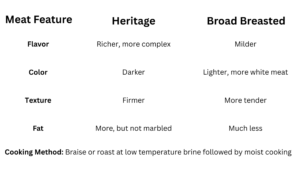
- More flavorful meat: firmer, but more flavorful
Features of Broad Breasted Turkeys
Broad breasted turkeys have these features:
- Modern genetics: selectively bred for fast growth and large breasts
- Appearance: bigger and more muscular
- Cannot mate naturally: require artificial insemination
- Shorter lifespan: 1 to 2 years, if not harvested sooner
- Poor for free-range: less active and alert to predators
- Cannot fly: too heavy to fly
- Low roost: 0 to 2 feet
- Poor health: the more they grow, the greater the health issues
- Fast growth rate: ready to harvest in 4 to 5 months
- Larger size: up to 15 pounds heavier
- Faster growth rate: good feed efficiency, but reliant on commercial rations
- More white meat: breast is twice the size
How to Cook Heritage vs. Broad Breasted Turkeys
Why Keep Heritage Turkeys?
If you want to raise poults (turkey chicks), heritage turkeys are the way to go. Broad breasted turkeys cannot mate naturally. They are too awkward because of their enormous weight and outsize chests. Heritage turkeys are therefore more sustainable. Raising them helps conserve the diverse genetic bloodlines of these historic native American birds.
Major Differences Between Heirloom and Broad Breasted Turkeys
What is the Difference Between Heritage and Heirloom Turkeys?
Heritage turkeys were standardized by the American Poultry Association before to the mid-20th century. Heirloom is a marketing term that describes turkeys with heritage breed ancestry, but which may be crossbreed from heritage bloodlines.
Are Heritage Turkeys Harder to Raise?
No, they are not harder to raise. They adapt better to the environment. They are better foragers, and they actively evade predators. Although broad breasted turkeys are ready to harvest sooner, they require more attention.
Will Heritage Turkeys Fly Away?
No, they are not likely to fly away. They may fly over a low fence, especially hens looking for a quiet place to nest. But they typically fly only short distances. Clipping one wing will keep them from flying over fences.
Are Heritage Turkeys Healthier to Eat?
Yes, heritage turkeys are healthier to eat. They free range, which gives them more protein and omega 3 fatty acids.
Do Heirloom Turkeys Have More Dark Meat?
Yes, they have a greater proportion of dark meat to light meat.
Which Turkey Tastes the Best?
In numerous taste tests, Bourbon Red and Standard Bronze turkeys come out ahead as having the most flavorful meat.
Are Heritage Turkeys Worth It?
Deciding to raise heritage vs. broad breasted turkeys depends on your personal preference and goals. Heritage turkeys are more sustainable, because they breed naturally. And the meat has a richer flavor and firmer texture. Broad breasted turkeys are not easily home bred. But they get bigger and grow faster, making the meat-producing project short term. The meat has a milder flavor and is more tender.
Helpful Links
- Definition & History of Heritage Turkeys
- How to Choose the Best Turkey Breed
- Heritage Turkeys from Cackle Hatchery®
- Broad Breasted Turkeys from Cackle Hatchery®
And that’s today’s news from the Cackle Coop.
Gail Damerow has raised chickens and various other poultry for more than 5 decades and has written numerous books about them, many available from the Cackle Bookstore.