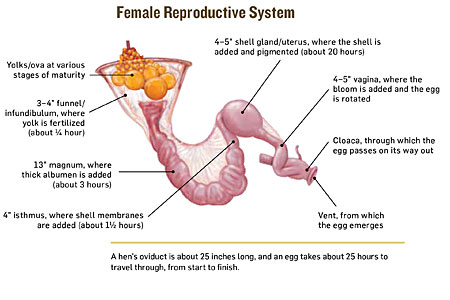
An egg begins in the hen’s ovary, where the yolk is created. Then it travels through the chicken’s oviduct, which is about two-feet long and has five separate compartments, each with a different and specialized function. Some 25 hours later, the egg exits the hen’s body. The process through which each egg develops is nothing short of miraculous. So how does a hen actually make an egg?
An Egg Starts with the Yolk
A hen’s reproductive system consists of two main parts: an ovary and an oviduct. A young female chicken, or pullet, starts life with two ovaries. As she matures, the right ovary remains undeveloped and only the left one becomes fully functional.
The functioning ovary contains all the ova — or undeveloped yolks — the pullet was born with, which represent the maximum number of eggs she could lay within her lifetime. The average number of ova per hen is about 4,000. Each tiny ova is enclosed in a thin sac, or follicle, providing nutrients by means of a network of blood vessels that surround the yolk.
When a pullet reaches laying age, one by one the tiny ova mature into a yolk. So at any given time during her productive life, the hen’s body contains yolks at various stages of development.
Within a span of about 10 days, one tiny yolk grows to a diameter of about one inch. Approximately every 26 hours, one yolk is mature enough to release into the funnel of the oviduct, a process called ovulation. Ovulation typically occurs within 1 hour after the hen laid her previous egg.
During ovulation the network of blood vessels rupture to release the yolk from the ovary. Sometimes the rupture isn’t perfect and a harmless spot of blood remains on the yolk.
If fertilization takes place, it will occur as the yolk passes through the oviduct’s funnel, or infundibulum. Afterward the yolk takes on a protective membrane, or vitelline.
Then Comes the Albumen
The yolk then spends the next three hours spiraling through the oviduct’s magnum, where it becomes surrounded in egg white, or albumen. The albumen is actually several different layers of varying thickness.
As the egg spirals through the magnum, the ends of the albumen layers twist together to form the chalazae. Those two white stringy things keep the yolk entered in the albumen and away from sticking to the shell.
The Shell Protects the Yolk and Albumen
Next the egg spends about one hour in the isthmus, where it acquires two thin, protective membranes. Now comes the longest, and most fascinating, part of the journey. The membrane-enclosed egg enters the shell gland, or uterus, where it spends the next twenty hours.
First fluid plumps it up until it achieves the approximate shape you would recognize as being an egg. Then it is sealed within a hard shell consisting of calcium carbonate crystals.
The function of the shell is to protect the egg’s contents — which, remember, contain a potential chick — from harm. But occasionally something goes wrong and the hen lays a soft shelled or shell-less egg.
The Hen Lays the Egg
Toward its end of development, the egg enters the hen’s vagina, where it is enveloped in a fast-drying protein solution called the bloom, or cuticle. The bloom seals tiny pores occurring between the calcium crystals that make up the shell. It also lubricates the egg’s passage through the cloaca and out the vent.
At this point the egg is leading with its small end. Just before it is laid, it rotates so the blunt end comes out first. A shell that plops into the nest on the blunt end is much less likely to crack. Clever, huh?
A freshly laid egg feels warm. That’s because a hen’s body temperature is about 106ºF. As the egg cools to ambient temperature, an air space develops between the two shell membranes. If you put a fresh egg into a bowl of water, it will sink. As it ages the air space enlarges until eventually the egg will float.
The entire development process takes about 25 hours, so a hen lays an egg a little later each 24-hour day. After laying about a dozen eggs, she’ll skip a day or more, then start a new multiple-day laying cycle.
Influences on a Hen’s Egg Quality
A hen’s genetics and age both influence the quality of her eggs. Genetically, some hens are better layers than others and produce higher quality eggs. And, despite her bloodlines, as the hen ages the quality of her eggs gradually declines.
Further, throughout the complex process of egg formation, a disruption that occurs during any phase can interfere with the egg’s development. Disruptions might be due to diet, environment, stress, disease, or temperature extremes. The result is what we call egg abnormalities, such as a thin or missing shell, calcium pimples on the shell, odd shapes, or watery white.
Summary, Phases of an Egg’s Development
- Yolk growth: 10-14 days
- Yolk release: 20-30 minutes
- Albumen layers: 3-4 hours
- Membranes form: 1-2 hours
- Egg shell added: 19-20 hours
- Bloom coating: mere minutes
- Next yolk release: 30-75 minutes
FAQs
How long does it take a hen to make one egg?
The average length of time for a hen to make an egg is about 25 hours.
What are the five compartments making up a hen’s oviduct?
- infundibulum or funnel
- magnum
- isthmus
- vagina
- uterus or shell gland
What is the function of bloom on an egg shell?
While it is still wet, the bloom lubricates the egg’s passage out of the hen. As it dries, it seals pores in the shell to protect the egg from bacteria and to slow evaporation through the shell.
Why doesn’t a hen lay an egg every day?
Most hens take a little longer than one day to make each egg. Even the top backyard layers generally produce no more than 300 eggs per year. Cackle Hatchery® helpfully indicates approximate egg production under breed facts for each breed.
How many eggs does a hen lay altogether?
The greatest number of eggs a hen can lay in her lifetime equals the number of ova she started with, which is about 4,000 on average. Exactly how may eggs a hen actually lays depends on the hen’s breed, temperament, diet, living conditions, and stress level.
How can I influence egg quality?
All the various steps in how a hen makes an egg affect the egg’s quality. You can influence the quality by choosing hens from genetic lines bred for quality egg production. Further, you can ensure your hens experience a minimum of disruptions to the process by:
- feeding the correct diet for layers
- including a free-choice calcium supplement
- providing constant access to fresh water
- ensuring your flock’s good health
- managing your flock to minimize stress
Helpful Links
Does a Hen Lay an Egg Every Day?
Why Do Eggs Come in Different Colors?
Why Does a Hen Lay a Miniature Egg?
Why Chickens Lay Eggs with Abnormal Shells
What Causes a Double-Shell Egg?
And that’s today’s news from the Cackle coop.
Gail Damerow has raised chickens and various other poultry for more than 5 decades and has written numerous books about them, most of which are available from the Cackle Bookstore. Illustration from The Chicken Health Handbook.