Most bantam breeds are smaller versions of a larger counterpart. True bantams, on the other hand, are naturally small chickens. Rather than having been selectively bred for size, many of the true bantam chicken breeds existed long before the development of most of the other chicken breeds we know today.
Difference between bantams and true bantams?
Most bantams are scaled-down versions of a larger chicken breed. Typically the breeding of bantam chickens requires selection for size to maintain the breed’s smallness. And, technically, a bantam breed — though producing smaller eggs — should lay as well as its larger counterpart.
True bantam chickens, on the other hand, come from distinct genetic lines that make them naturally small. So, unlike most bantam breeds, true bantams have little need to be selectively bred for size. While true bantams tend not to lay real well, most of them make terrific broody hens that can be more reliable than a mechanical incubator.
Cackle Hatchery® offers these true bantam chicken breeds:
Belgian d’Anvers
Belgian d’Anvers bantams get their name from the Belgian municipality of Antwerp, which is “Anvers” to the French. The word d’Anvers therefore means “from Anvers/Antwerp.” Other names for this breed are Antwerp Belgian and Bearded d’Anvers.
This true bantam comes in a number of different color varieties. It has a rose comb, small or no wattles, a full beard, and muffs that cover the earlobes. The hens lay small eggs with white shells and tend to go broody.
Belgian d’Uccle
Belgian d’Uccle bantams get their name from the Belgian town of Uccle. They came about by crossing Belgian d’Anvers with Booted Bantams (another true bantam breed). The goal was to achieve a bantam with both a beard and leg feathers, or boots. Another name for this breed is Bearded d’Uccle.
Like the d’Anvers, this true bantam comes in several color varieties. It has a single comb, small or no wattles, a full beard and muffs, and fully feathered legs with vulture hocks. The hens lay small eggs with white shells, and they readily brood.
Japanese Bantam
The Japanese bantam is an ancient breed originating in Japan. This true bantam has a large tail in proportion to its size. A Japanese rooster carries this outsize tail so far forward that the feathers nearly touch the back of his head.
Other features include a large single comb and long drooping wings. The Standard calls for unusually short legs, which are associated with the lethal creeper gene.
These little birds, which come in several color patterns, are highly capable fliers. The hens lay eggs with brown shells and make excellent broodies.
Rosecomb Bantam
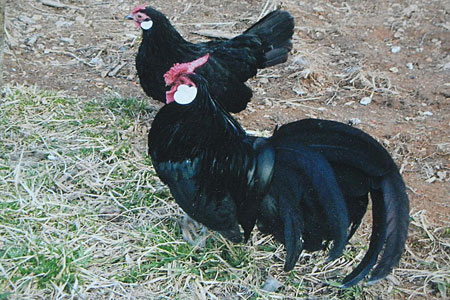
The Rosecomb is an old breed of true bantam originating in England as a gorgeous ornamental chicken. It is named for its prominent bright-red rose comb. The Rosecomb bantam has white earlobes and a full tail that’s large in relation to its small, compact body, and it comes in numerous color varieties.
Rosecomb eggs tend to be low in fertility, as is common among breeds having a rose comb. The chicks that do hatch are extremely delicate, requiring extra care to raise. But once they reach maturity these bantams are hardy and active, as well as being capable fliers. The hens are rather poor layers of eggs with tinted shells, and seldom brood.
Sebright Bantam
The Sebright is another old breed of true bantam from England, the creation of Sir John Sebright. These bantams are unique among chickens in being hen feathered, which means the roosters, like hens, have rounded hackle and saddle feathers. Sebrights come in two color patterns, both laced — silver and golden.
Sebrights have a rose comb and, like the Rosecomb breed, their eggs tend to be low in fertility. And, similarly, the chicks are tiny and delicate, and so require extra care. But mature Sebrights are hardy, active, and capable fliers. The hens tend to be poor layers of small eggs with white shells. And they seldom brood.
Silkie Bantam
Most likely the Silkie originates from China, although it sometimes goes by the name of Japanese Silkie. Whether or not it is a true bantam chicken is a matter of some contention. Although backyard Silkies in the United States are often promoted as true bantams and are bred to weigh no more than three pounds, at ethnic Chinese markets you can find Silkies that weigh four pounds or more.
The breed name refers to this chickens’ fluffy, furlike plumage. These birds have a crest, a walnut comb, turquoise earlobes, leg feathers, and five toes (some have six). The skin and shanks are black, and the face, comb, and wattles are dark purple. They may be either bearded or nonbearded, and come in several color varieties, the most common ones being white and black.
Silkies are popular bantams because they are super friendly and they can’t fly. The hens are decent layers of small, tinted eggs. They are such good setters that many chicken keepers have them solely for incubating the eggs of rare or nonbrooding poultry.
Unique appearance of true bantams
Many of the true bantam breeds have a unique appearance that enhances their appeal. For instance:
- Belgian d’Anvers chickens sport a beard and muffs
- Belgian d’Uccle additionally has fully feathered legs
- Japanese are noted for droopy wings, short legs, and large tail
- Rosecomb has a large tail and outsize white earlobes
- Sebright has laced feathers and is uniquely hen feathered
- Silkie has furlike feathers, turquoise earlobes, and five toes
FAQs
Are all bantam chickens true bantams?
No. Most bantam breeds are scaled-down versions of similar but larger breeds.
What is a true bantam chicken?
A true bantam chicken breed is one that is naturally small and does not require selective breeding to maintain size. True bantams existed long before the development of most of our modern chicken breeds.
Why keep true bantam chickens?
True bantam chickens are valued for these features:
- Unique appearance
- Popular at exhibition
- Friendly disposition
- Great as pets
- Broody hens
Helpful Links
10 Reasons to Keep Bantam Chickens
And that’s today’s news from the Cackle Coop.
Gail Damerow has raised chickens and various other poultry for more than 5 decades and has written numerous books about them, most of which are available from the Cackle Bookstore.