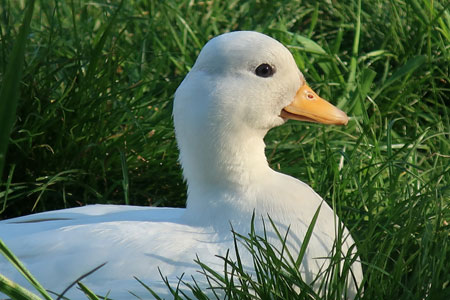
Call ducks are the smallest domestic duck breed. Compact and feisty, they have tiny, round bodies, short necks, small heads, and short bills. These ducks come in numerous colors, not all of which are admitted to the American Standard of Perfection.
How did this duck breed get its name?
In the 1600s, Call ducks were used by hunters in the Netherlands as live decoys to attract wild ducks with their loud quacking. At that time they were called decoy ducks or simply coy ducks.
Today the Migratory Bird Treaty Act bans their use for hunting wild waterfowl. Instead they are now kept as pets or ornamentals, and are also the most popular duck breed for exhibition.
What color is a Call duck?
They come in numerous colors. Gray is the original color. It is similar to a mallard, from which this breed derives. White is the most popular today.
Are Call ducks APA approved?
Of the many color varieties available, nine have been approved by the American Poultry Association Standard of Perfection. They are Blue Fawn, Blue (aka Blue Bibbed), Butterscotch, Buff, Chocolate, Gray, Pastel, Snowy, and White. The White and Gray varieties were the first to be admitted to the Standard in 1874, making this a Heritage breed.
Call ducks offered by Cackle Hatchery®
Cackle Hatchery offers an assortment that may include any of the following color varieties:
|
Variety |
Color |
APA Year |
|
Black |
All black |
N/A |
|
Blue (Blue Bibbed) |
Dark blue, white bib |
1977 |
|
Gray |
Multicolor, like a Mallard |
1874 |
|
Pastel |
Pale, soft hues |
1996 |
|
Pencil |
Patchy brown, white, black |
N/A |
|
Snowy |
Creamy w/ lacing |
1982 |
|
White |
All white |
1874 |
Are Call ducks easy to raise?
Calls bred for show can be difficult to raise. However, unlike the extremes of exhibition birds, Cackle Hatchery’s Call ducks have a more natural shape, which improves their lifespan and ability to reproduce.
What do Call ducks eat?
Feed ducklings a duck starter ration. If that’s not available, you may need to use a starter not formulated for ducklings. In that case it must be fortified to prevent niacin deficiency, which results in leg deformities and lameness. To prevent deficiency, supplement any nonduck starter ration with food-grade brewer’s yeast at the rate of 3½ cups per 10 pounds of starter.
Niacin deficiency affects ducks up to about 10 weeks of age. By the time they are mature enough to lay, they no longer require a niacin supplement.
Feed mature birds a waterfowl ration if you can get it, otherwise a quality layer ration. If they don’t have plenty of forage, supplement with fresh produce and mealworms.
What are the pros and cons of keeping Call ducks?
Pros:
- Robust when mature
- Small size, requiring less space
- Easy to tame
- Friendly and sociable
- Good with children
- Active and adorable
Cons:
- Delicate as ducklings
- Slow growth rate
- Loud, high-pitched quack
- Vulnerable to predation
- Like to fly
- Not prolific layers
Do Call ducks require a permit?
You do not need a federal permit. But many municipalities regulate backyard poultry, sometimes requiring a permit, license, or zoning approval. Regulations may also limit numbers, noise, and setbacks. To be certain, check with your local HOA, as well as animal control, zoning department, and state wildlife agency.
FAQs
What size is a Call duck?
A mature hen weighs 20 ounces. A mature drake weighs 26 ounces.
How much space to Call ducks need?
Per duck, 4 square feet in the shelter, 10 to 12 square feet of protected space outdoors.
Can Call ducks live with chickens?
They get along well with bantam chickens. But, because of their small size, they don’t do well with larger chickens or even larger duck breeds.
Do they need a pond?
They would not be happy without at least a wading pool for bathing, breeding, and general splashing around.
Will Call ducks fly away?
They might occasionally test their wings. But when you raise them from ducklings, they will not be inclined to fly away from their known source of food, water, and shelter..
Are Call ducks vulnerable to predators?
Yes. Because they are so small, they have no way to defend themselves against all kinds of predators. They require a secure enclosure for protection.
Are Call ducks rare?
Some colors are common, others are very rare. Of the colors offered in Cackle Hatchery’s assortment, Black, Blue, and Pencil are uncommon. Snowy is somewhat uncommon. White, Pastel, and Gray are very common.
Are Call hens good layers?
The hens lay 25 to 75 eggs per year, which is not as prolific as other duck breeds.
What color eggs do they lay?
Call hens lay small eggs that usually have white shells. The occasionally hen will lay eggs with green or blue-tinted shells.
Are Call hens broody?
Call hens rarely brood. But when they do, they are excellent mothers that take great care of their delicate ducklings.
Are Call ducks friendly?
Yes, they are friendly, inquisitive, and intelligent. When handled as ducklings, they are easy to tame, and they socialize well with humans.
How long do Call ducks live?
Well cared for, Call ducks should live 10 years or more.
Helpful Links
How Many Eggs Does a Duck Lay?
Furnishing Nests for Laying Ducks
How to Handle Duck Eggs for Eating
And that’s today’s news from the Cackle Coop.
Gail Damerow has raised ducks, chickens, and various other poultry for more than 5 decades and has written numerous books about them, include The Absolute Beginner’s Guide to Raising Backyard Ducks, available from the Cackle Bookstore. Image by Sylvia Sage from Pixabay.