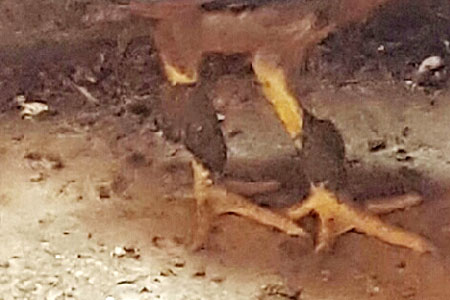
Mud balls are dark, hard lumps clinging to a chicken’s toes and sometimes the shanks. Some mud balls consist of mostly chicken poop. Others consist mostly of mud. In either case, more poop, mud, and other debris adds to the accumulation. Before long the poor chicken is trying to walk with sizable cement-hard balls clinging to its toes. Here’s how mud balls form on a chicken’s toes and how to easily remove them.
Where do mud balls come from?
Inside a chicken coop where moist droppings accumulate, bits can cling to a chicken’s toenails. As the original poop dries, more poop sticks to it, creating ever larger balls.
In a muddy yard, the same thing happens. Only here it may start with muddy dirt combined with chicken droppings.
Even chicks in a brooder can develop mud balls. In this case the balls consist mostly of moist poop mixed with chick starter. Generally chick mash creates more of a problem, because it is finer than crumbles.
Most mud balls start on a chicken’s toenails. But they can also accumulate on the chicken’s shanks, creating mud-caked anklets.
Mud balls may be the size of a marble or bigger than a walnut. They are both unsightly and uncomfortable for the bird, especially one with feathered legs and feet. Mud balls remaining on the toes can grow quite large, eventually leading to crippling or infection.
How to safely remove mud balls from a chicken’s toes and shanks.
The internet is rife with ways to remove mud balls from a chicken’s toes and shanks. Among the most common methods are to use pliers to crack the dried mud, or to tap the hard mud with a hammer until it shatters. If not done with great care, though, either method can result in a broken leg or toe.
To safely remove mud clinging to a chicken’s shanks or feet, stand the bird in warm, not hot, water. Soon the hardened mud will softened, at which time you can gently squeeze the ball and it should pop right off.
Large balls may require 15 minutes or more of soaking before they soften enough to crumble and come off easily. For a substantial mud ball with deep layers, you may have to pick off each layer between repeated soakings. On breeds with leg feathers, use scissors to cut away mud balls on the feathers.
To help the mud balls soften faster, add a bit of mild dish liquid to the water. When the chicken’s feet and shanks are clean, gently brush them with an old soft toothbrush and warm soapy water.
After the toes are clean and dry, they may bleed bit. In that case, coat them with povidone iodine. And be sure to correct the conditions that caused the problem in the first place.
How to avoid mud balls.
Inside the coop, or in a chick brooder, remove moist bedding and frequently remove accumulated droppings. Feed chicks starter crumbles instead of mash.
If your soil is not high in sand nor gravel, which dries rapidly, minimize muddy conditions by having a chicken yard that slopes away from the coop. A south-facing slope, open to full sunlight, dries fastest after a rain.
Whatever you can do to eliminate moist conditions will help prevent mud balls. Additionally, watch for mud balls starting on a chick’s or chicken’s toes and legs, and remove them while they are still small.
Frequently Asked Questions
Are mud balls the same as bumble foot?
No. Bumblefoot is a swollen abscess at the bottom of a chicken’s foot. Mudballs accumulate on the chicken’s toes and shanks.
Are mud balls a type of growth?
No. Mud balls are simply an accumulation of chicken poop, mud, and other debris.
Is it bad for chickens to have muddy feet?
Yes. Mud on a chicken’s feet can dry, then accumulate more mud that dries, and so forth, creating mud balls.
Why is it important to remove mud balls right away?
The sooner you discover the presence of mud balls, the easier they are to remove.
How to remove mud balls from a chicken’s toes?
To remove mud balls from a chicken’s feet and shanks, soak them in warm water until the poop and mud softens enough to easily fall away.
And that’s today’s news from the Cackle Coop.
Gail Damerow has raised chickens and various other poultry for more than 5 decades and has written numerous books about them, many available from the Cackle Bookstore.