Do you deworm your chickens too often, or not often enough? Whether your chickens need deworming, and how often, has no one-size-fits-all answer. Factors that influence whether or not you should deworm your chickens include the type of worms present in your environment, how you house your chickens, and your climate.
Why deworming is important.
A serious worm load affects chickens in a number of ways:
- It weakens their immune system, making them more susceptible to disease.
- It interferes with nutrient absorption, hindering growth and egg laying.
- A worm load can result in blood loss, leading to anemia.
- A severe load can block the intestines or windpipe, resulting in death.
Parasite worm lifecycles and their importance.
Each parasitic worm species has one of two types of life cycles: direct and indirect. Direct-cycle worms move from one chicken to another by means of worm eggs or larvae expelled by an infected chicken into the environment. The worm eggs or larvae are then eaten by another chicken that thereby becomes infected.
Indirect-cycle worms must first enter some other creature during an immature stage of their lives. Such a creature, called an alternate host, might be an ant, beetle, earthworm, fly, grasshopper, slug, snail, or termite. A chicken gets infected by eating the alternate host. More than half the worm species that infect chickens have indirect life cycles.
Parasitic worms and their alternate hosts.
Effective parasitic worm control therefore involves monitoring alternate hosts that can potentially infect your chickens. Beetles and grasshoppers, for instance, are more abundant in late summer. Earthworms come to the soil’s surface after a heavy rain. Slugs and snails are more plentiful in warm, wet weather than in either cold weather or hot, dry weather.
The worm species that affect chickens, and their alternate hosts:
|
Parasitic Worm |
Alternate Host |
|
Capillary worm (Capillaria spp.) |
None (direct cycle) or earthworm |
|
Cecal worm (Heterakis gallinarum) |
None or beetle, earwig, grasshopper |
|
Crop worm (Gongylonema ingluvicola) |
Beetle, cockroach |
|
Eye worm (Oxyspirura mansoni) |
Surinam cockroach (tropical) |
|
Gapeworm (Syngamus trachea) |
None or earthworm, slug, snail |
|
Gizzard Worm (Amidostomum Anseris) |
Beetles, grasshoppers, weevils |
|
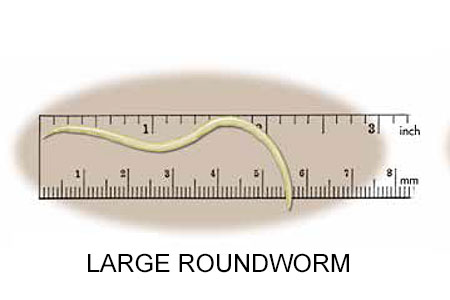
Large roundworm (Ascaridia galli) |
None |
|
Stomach worm (Tetrameres americana) |
Cockroach, grasshopper |
|
Tapeworm (Eucestoda) |
Ant, beetle, earthworm, slug, snail, termite |
Of these, the cecal worm is the most common parasitic worm in North American chickens. But, other than carrying blackhead — to which chickens are typically resistant, but turkeys are not — the cecal worm does not seriously affect a chicken’s health.
How housing affects worm loads.
Housing affects the presence or absence of alternate hosts.
- In a cage, chickens are most likely to be infected by flies.
- Penned chickens on litter are most likely to be infected by cockroaches, beetles, and other indoor-living creatures.
- Free range flocks are more likely to be infected by earthworms, grasshoppers, slugs, snails and other outdoor-living creatures.
How to reduce exposure to worms.
Indoors, reduce the spread of direct cycle parasites by having a droppings pit beneath roosts so chickens can’t pick in the accumulation, or by frequently cleaning out the droppings. After deworming, thoroughly clean out and replace litter to reduce the speed of reinfestation.
Outdoors, rotate the run and either till the soil or mow vegetation in the previous run. Doing so reduces the overall parasite population by exposing expelled worms, larvae, and eggs to drying sunlight.
Influence of climate on worm loads.
These climates typically require dewormimg less often:
- Cold climate — alternate hosts are inactive for part of the year.
- Warm, dry climate — worm eggs and larvae dry up and die when exposed to air and sunlight.
These climates typically require more aggressive treatment:
- Warm, humid climate — alternate hosts are prevalent year around.
- Rainy climate — moisture and mud protect worm eggs and larvae from drying out.
How to tell your chickens are wormy.
Some of the signs that chickens are wormy include these:
- Losing weight while eating well
- Pale comb and wattles
- Droopiness and lethargy
- Sudden reduction in egg laying
- Unkempt appearance
- Diarrhea or abnormal droppings
- Worms visible in droppings
Wormy chicken don’t always show obvious signs. The only way to know for sure if and when your chickens need deworming is through regular fecal exams.
Most veterinarians offer fecal exams for a nominal fee and can tell you if your chickens are wormy, what kind of worms they have (if any), and how often they might require deworming. A veterinarian can also prescribe off-label products that are not otherwise approved for poultry.
If you wish, you can learn to do your own fecal tests. Directions are freely available on various websites. Details are also provided in The Chicken Health Handbook.
What type of dewormer to use for chickens.
Of the many livestock dewormers on the market, the only one that the FDA approves for chickens is piperazine, sold under the trade name Wazine. In chickens it is effective only against large roundworms, the most common of the harmful internal parasites. It is also a human treatment for roundworms and pinworms.
Further, Piperazine affects only adult worms, not young worms that might be present within the chicken’s body. Treatment must therefore be repeated in 7 to 10 days to catch young worms that have matured and released their hold on the intestinal lining.
USDA does not approve Piperazine for hens laying table eggs. The withdrawal period for meat birds is 14 days.
How often should you deworm your chickens?
The indiscriminate routine use of any chemical product is not the best answer to parasite control. Repeated use causes worms to eventually become resistant to the product.
Although there are no hard and fast rules, here are some guidelines:
- Deworm immediately if you know your chickens are carrying a heavy worm load.
- Every 3 months in an environment or climate that requires an aggressive approach.
- Each spring (when worm eggs become more infective) and fall (as infectious worms wind down) as a preventive measure.
How to increase a flock’s resistance to worms.
Chickens are more resistant to large round worms when their diet is high in calcium, vitamin A, and the B-complex vitamins. Further, heavier breeds such as Rhode Island Red and Plymouth Rock are more resistant than lighter breeds such as Leghorn and Minorca. And birds that are older than 3 months are more resistant than younger birds.
It’s comforting to know that once a healthy chicken reaches maturity, it becomes relatively resistant to parasitic worms. Most mature chickens therefore are less in need of routine deworming.
Frequently Asked Questions
Can chicken eggs get worms in them?
Large roundworms occasionally migrate to the cloaca and up the oviduct, getting trapped inside a newly forming egg. You can detect such worms by candling eggs before eating or selling them.
Can apple cider vinegar deworm chickens?
The acidity in apple cider vinegar may prevent parasitic worms from thriving, but there is no evidence that it is effective against an existing worm load.
Is garlic an effective dewormer?
Garlic supports a chicken’s immune function. And it may prevent some parasite species from developing into larvae. But there is no evidence that garlic is effective against an existing worm load.
Is diatomaceous earth an effective dewormer?
DE may reduce susceptibility to worms, but there is no evidence that it is effective against an existing worm load.
Will pumpkin seeds deworm chickens?
Pumpkin seeds are marginally effective against tapeworms. But there is no evidence that it is effective against an existing worm load.
What is the best natural dewormer for chickens?
No scientific studies have proven the effectiveness of any natural methods of parasitic worm control. So don’t rely entirely on natural methods unless you are certain your chickens are not suffering from an overload of worms.
However, most natural remedies have some nutritional value. Therefore they are likely to benefit your chickens’ overall health, increasing their resistance to parasitic worms.
And that’s today’s news from the Cackle Coop.
Gail Damerow has raised chickens and various other poultry for more than 5 decades and has written numerous books about them, many available from the Cackle Bookstore.