Some 75.5 million Americans — or about 30% of the entire population — live in a community governed by a Homeowners Association (HOA), according to the Foundation for Community Association Research. Further, the 365,000 different HOAs each enforce their own set of rules. And not all Homeowners Association rules allow chickens. Chickens and HOAs An […]
A child’s initial experience with chickens is often the most memorable. To ensure that the youngster’s introduction to chickens is pleasant and fun, consider these qualities when choosing the best first chickens for kids: They are calm in disposition They are friendly with people The breed is appropriate for small hands The chickens enjoy hugs […]
For exhibition purposes, large chicken breeds recognized by the American Poultry Association (APA) are organized into six classes. Most of the classes represent the geographic region where the breeds originated or were developed. Knowing a chicken’s APA class lets you infer a number of things about the breed, including temperament, laying ability, climate tolerance, and […]
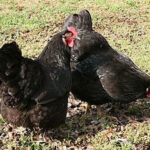
Black Australorp chickens were developed in Australia by crossing black Orpingtons from England with other breeds that are good egg layers. The idea was to develop farmstead chickens that excel in egg production. The breed name comes from combining the words Australia and Orpington. Physical Attributes The United States favors Australorps that are black, although […]
Chickens, including bantams, tend to do better in cold weather than in hot weather. However, some bantams tolerate the cold better than others. Certain features — such as dense plumage, leg feathering, beards, and small combs — contribute to a cold hardiness. Often the country of origin provides a clue to a breed’s climate tolerance. […]
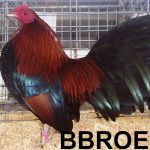
Chicken keepers often use abbreviations and assume their listeners know what they mean. Here are some of the more common chicken breed abbreviations, along with abbreviations for variety features and those used for show that may be puzzling when you see them in poultry publications, forums, and websites. Note that abbreviations may be combined to […]
“The shredder gene in lavender chickens causes the feathers to split and the barbs to detach, resulting in rough looking feather development,” explains Jeff Smith of Cackle Hatchery®. Lavender, also known as self blue, is a plumage color resulting from an autosomal recessive gene. Let’s explore how it works. Lavender vs. Blue The lavender gene […]
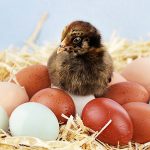
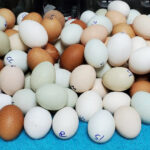
Like a lot of chicken keepers, you might want to include a variety of breeds in your backyard flock. Maybe you look forward to gathering baskets full of colorful eggs. Or, rather than all one breed of the same color and type, you prefer a more interesting variety of colors, sizes, and personalities. Or maybe […]
Although the age at which hens start laying eggs depends on many factors, the ultimate factor is the breed. Some breeds mature fast and start laying as early as 4 months of age, while others mature more slowly and start laying much later. Below are just a few of the many chicken breeds, along with […]
Eggs need to be placed on a separate order and not with other birds. The egg orders are manually scheduled and you will receive your notice of your ship date within 24 to 48 hours.